

Why is the correct pencil grip necessary?
It is important that children develop the correct pencil grip during their preschool years. This is because without the correct pencil grip they often struggle to keep up with writing and fine motor tasks in their primary school years and the neatness of their work can be negatively affected.
Stages of development of the pencil grip
Illustrated below are the four stages of pencil grip development that the young child will most likely move through until a mature pencil grip is established:
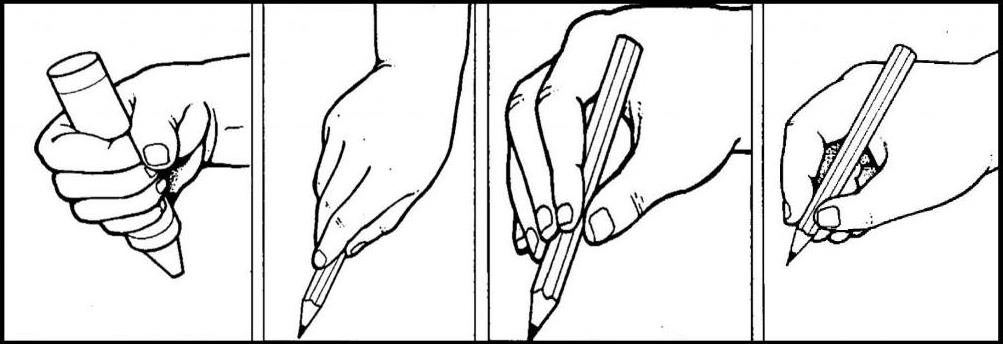
Please note: It is not necessary for a very young pre-schooler to be encouraged to use a more advanced pencil grip before he or she is developmentally mature enough to do so! In fact, this may create more problems for the child. Each stage is the perfect pencil grip for that age.
What is necessary for a child to develop the correct pencil grip?
A correct pencil grip is dependent on adequate gross and fine motor skills. Gross motor skills are larger movements a child makes with his arms, legs, or feet, or his entire body, e.g. crawling, running, and jumping. Fine motor skills are the small movements that occur in the hands, wrists, fingers and feet. They are the smaller actions that occur, for example, when using a fork to eat and using a pen to write.
In the developing child, the larger muscles will develop before the smaller, fine muscles. The muscles at the centre of the body will develop before the muscles further away from the core. A child will therefore first start developing postural control, shoulder stability, arm strength, wrist stability, hand strength then finger strength and manipulation. All of these skills are needed in order to develop a pencil grasp. If a child has difficulties with posture, core strength and motor control, they can have difficulty with their fine motor output and the development of a mature pencil grasp. Writing is not just impacted on by fine motor aspects such as pencil grip but it is also influenced by the development of appropriate perceptual and cognitive skills.
Activities for the development of fine motor skills
There are many fun play activities which will help develop a child’s muscle strength in the fingers and hands. Examples of these are:
- Pinching, poking and squeezing activities e.g. playdough, stress balls, crumpling newspaper balls, paper/cardboard tearing, popping bubble wrap
- Threading and lacing activities e.g. beads, straws (cut into pieces), buttons or noodles
- Pinching the index finger and thumb together e.g. using tweezers to pick up objects, eye droppers, seperating a mixture of beans/lentils/corn
- Finger rhymes and games which encourage the child to stretch, curl and isolate their finger movements e.g. “1 little, 2 little, 3 little Indians” and “incy wincy spider”
- Strengthening the thumb in a position away from the palm e.g. large spray bottles, syringes, playdough syringes, cutting activities, opening/closing pegs.
There are many other fun creative preschool pre-writing activities such as finger painting with paint or foam, painting with brushes, chalk drawing, drawing in sand, tracing and dot-to-dot activities.

Ideas for the remediation of pencil grip difficulties
The following ideas may be helpful for the older pre-schooler who displays an incorrect pencil grip:
- Teach the child to use his fingers like a crab. He turns his thumb, pointing finger and middle finger into ‘a crab’ which pinches the pencil, while the ring and pinky fingers ‘sleep’.
- Let the child hold a small object, e.g. a button, with the ring finger and little finger while holding the pencil with the other three fingers.
- Draw two eyes at the tip of the pencil / koki and have your child use their thumb and forefinger as “glasses” on the eyes when using these tools.
- Another idea is to attach the pencil to their hand with a rubber band. Put the rubber band around the wrist and twist it once or twice and put the second loop over the pencil. The tension created reminds the child to keep the pencil in the correct position.
- A variety of moulded plastic and foam pencil grips are available at shops such as Playworld and CNA.

If attempts by the teacher and parents to correct a child’s pencil grip are not successful, it is best to consult an occupational therapist for a screening or assessment to establish the underlying reason for the problem and whether intervention is necessary. While the most efficient way to hold a pencil is the dynamic tripod grip, many other patterns are commonly seen in children and it does not always require intervention and modification. In certain cases if a child assumes a comfortable pencil grip that is not “correct” and the teacher deems it to be functional, i.e. the child is displaying normal fine and gross motor skills in the class room and the child is completing desk-top activities at an adequate speed, then intervention may not be deemed necessary. If the child is using a grip with 5 fingers, tucking or wrapping the thumb, or the web space (between the thumb and index finger) is closed then these constitute ineffective grasp patterns.
Article by Heather Light
These links are recommended for further reading and excellent ideas:
http://www.ot-mom-learning-activities.com/pencil-grasp-development.html