
Six Bricks
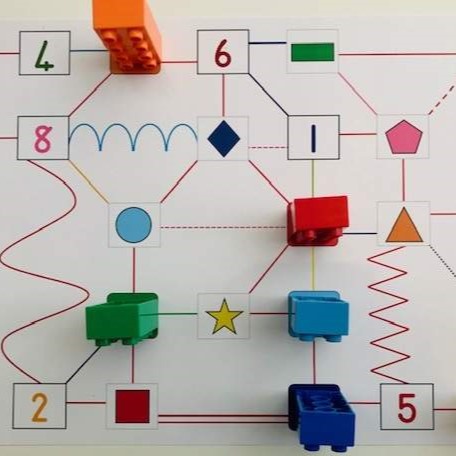
Coding and robotics with six bricks is a hands-on approach to teaching coding and computational thinking skills to children using Duplo bricks. A pedagogical approach developed by Care for Education and the LEGO Foundation that uses short, simple exercises to support all areas of development in the curriculum. A basic set of six different coloured DUPLO bricks are used to encourage children to construct and deconstruct ideas and concepts, developing their perceptual skills.
The idea of using Six Bricks is based on a belief that children need to be exposed to perceptual (obtaining information from senses) and motor (learning to move with control and efficiency) experiences, which require them to use their brain and body together. This is important for most classroom activities such as writing, where the child must know the alphabet and how words are formed by combining letters. The child must then transform this knowledge into action such as gripping, stabilizing and moving the pencil. The child’s perceptual skill of sight will be used to adjust the movements to create the required pattern or shape. This example illustrates how the mind and body must work together.
Performing physical activities also build neural pathways and the more neural pathways the brain has, the easier it is to learn. Perceptual-motor skills are necessary and important in preparing the child’s brain for learning as they build that strong base to support future academic learning.



Benefits
Coding develops language skills, organizational and problem-solving skills, curiosity, creativity, and confidence. Six Bricks activities help to develop core learning skills such as self-regulation, curiosity, creativity & playfulness. This supports the foundation for all later learning, as children solve problems, understand themselves, others and the world around them.
Aim
The approach aims to create confident problem solvers by teaching students the foundational knowledge and skills needed for programming and robotics.